.png)
EMDR Therapy Explained: The 8-Phase Protocol, Benefits & Professional Training Guide

Updated: Dec 22, 2025

Eye Movement Desensitisation and Reprocessing (EMDR) is widely recognised as one of the most effective treatments for trauma. Endorsed by the World Health Organisation (WHO) and the American Psychiatric Association, it has become a critical tool for modern mental health.
But what exactly is it? Is it just for patients with PTSD, or is it a career-defining skill for therapists?
This comprehensive guide explores the neurobiology of Adaptive Information Processing (AIP), the mechanics of Bilateral Stimulation, and how you can access treatment or become a certified specialist in Asia.
The Core Idea: Adaptive Information Processing (AIP)
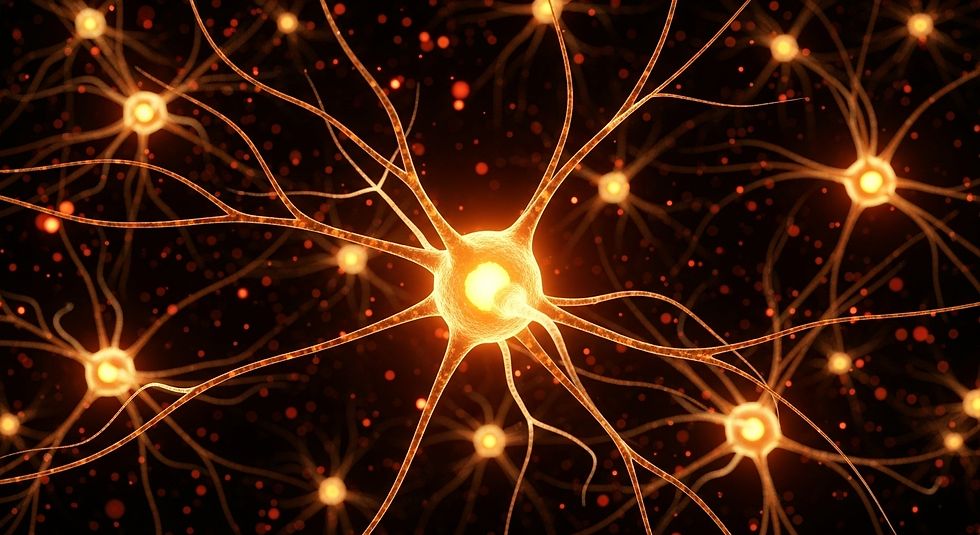
At the heart of EMDR therapy is the Adaptive Information Processing (AIP) model. This model posits that the brain possesses an innate capacity to process and integrate disturbing memories.
When a traumatic event occurs, this natural processing system can become overwhelmed. The memory, along with its associated emotions, thoughts, and physical sensations, gets "stuck" or improperly stored in the brain's neural networks (specifically, the Amygdala and Hippocampus).
These "stuck" memories can be easily triggered, leading to ongoing emotional dysregulation, maladaptive behaviours, and a sense of being "back in time" (e.g., flashbacks, intrusive thoughts). EMDR therapy helps to reprocess these memories, promoting lasting emotional healing.
The Science: Why Bilateral Stimulation (BLS) Works

Bilateral Stimulation (BLS) is the distinct physiological component of EMDR that separates it from talk therapy. It refers to the rhythmic, alternating stimulation of the left and right sides of the brain.
You may be searching for "bilateral stimulation emdr" to understand why moving your eyes can heal trauma.
The answer lies in two leading neurobiological theories:
Theory A: The Working Memory Taxation Theory
When you hold a distressing memory in your mind, it is vivid and emotional. It consumes your "working memory" capacity. By asking you to simultaneously focus on an external stimulus (like following a light bar or tapping), we force your brain to multitask.
The brain has limited processing power. It cannot hold the full emotional intensity of the memory and focus on the eye movements at the same time. The result? The memory blurs. It loses its emotional "sting," allowing it to be reconsolidated as a neutral fact rather than a relived trauma.
Theory B: The REM Sleep Mechanism
Research suggests BLS mimics REM (Rapid Eye Movement) sleep, the phase where the brain naturally processes daily emotional events. During REM, your eyes move rapidly back and forth as your brain sorts and files memories. EMDR replicates this state while you are awake and focused, manually jump-starting the brain’s stalled filing system.
The Three Modalities of BLS: Professional EMDR training covers multiple modalities to suit different clients:
Visual: The client follows the therapist's fingers or a light bar moving back and forth.
Auditory: Alternating tones delivered through headphones (ideal for clients who get migraines).
Tactile: Rhythmic tapping on the client's hands or knees (often used for children or clients who cannot tolerate eye movements).
The Path to Healing: A Deep Dive into the 8 Phases
EMDR is not a free-form conversation; it is a rigorous, standardised protocol. This structure is what ensures client safety.
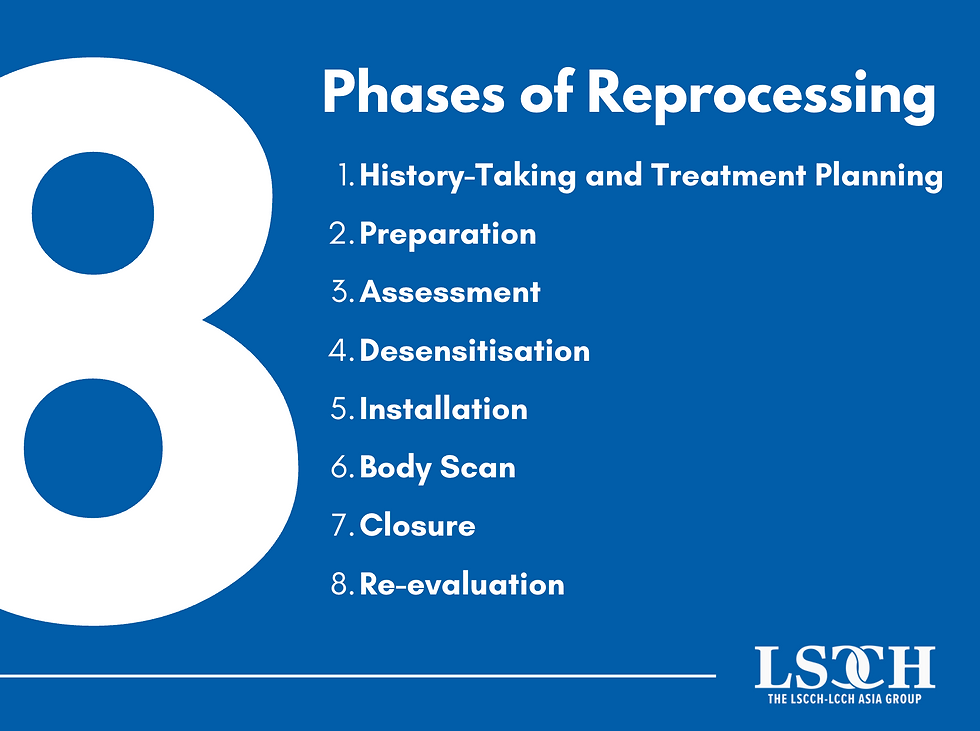
Phase 1: History Taking & Treatment Planning
The therapist identifies the specific "Target" memories. Unlike talk therapy, we do not need to discuss every detail of the trauma yet. We map out the "clusters" of memories that drive your current symptoms.
Phase 2: Preparation (Resourcing) This is the safety phase.
Before any processing begins, the therapist ensures you have the tools to handle emotional distress. You will learn techniques like the "Safe Place" or "Container Exercise" to calm your nervous system immediately. At LCCH Asia, we integrate Clinical Hypnosis here to accelerate this stabilisation.
Phase 3: Assessment
We activate the memory. The therapist helps you identify:
The Image: The worst part of the memory.
The Negative Cognition (NC): The core belief about yourself (e.g., "I am helpless").
The Positive Cognition (PC): What you want to believe (e.g., "I am in control").
SUDs Score: Subjective Units of Disturbance (0–10).
Phase 4: Desensitisation
This is the processing engine. You focus on the image while the therapist applies Bilateral Stimulation. We continue in "sets" until your SUDs score drops to 0 and the memory feels neutral.
Phase 5: Installation
We do not just remove the bad; we install the good. We pair the Positive Cognition ("I am safe now") with the neutral memory and use BLS to strengthen this new neural connection.
Phase 6: Body Scan
Trauma is often somatic (stored in the body). You mentally scan from head to toe. If you feel tightness in your chest or stomach, we process that sensation with further BLS until the body is physically calm.
Phase 7: Closure
Every session ends with stabilisation. Whether the memory is fully processed or not, you will never leave a session feeling "open" or raw. We use the resources from Phase 2 to ensure you are grounded.
Phase 8: Re-evaluation
At the start of the next session, we check: Did the changes hold? We verify that the memory is still neutral before moving to the next target.
What Does an EMDR Session Actually Look Like?
If you are considering this therapy, or training to provide it, it helps to visualise the experience.
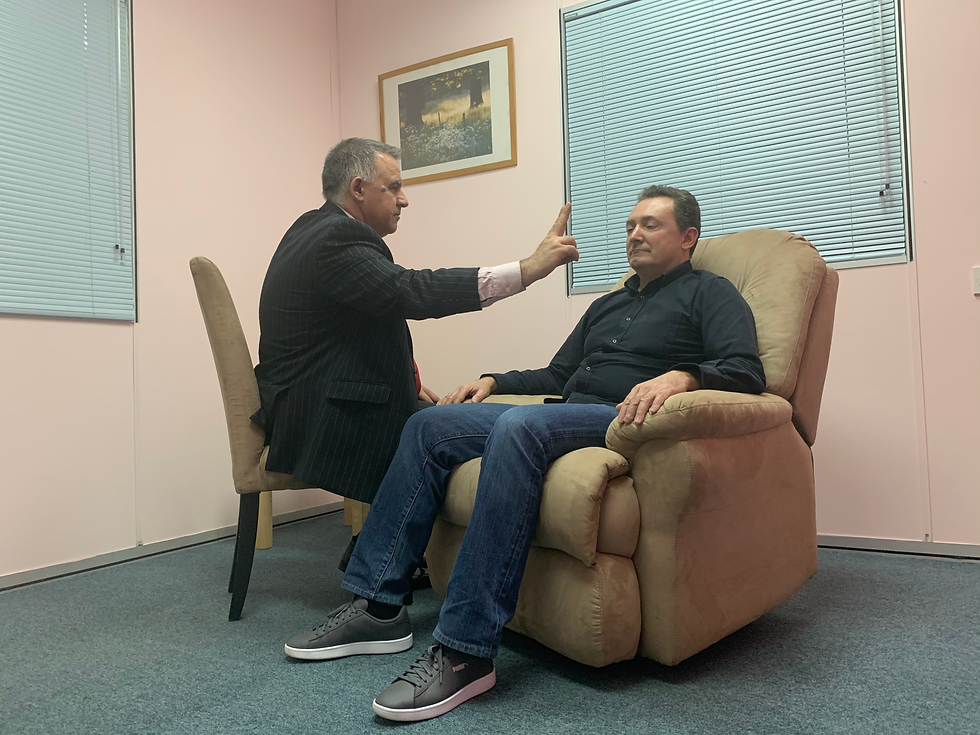
An EMDR session is typically 60 to 90 minutes. Unlike standard counselling, there is less talking. The therapist acts more like a guide or a coach.
You are in control: You are not in a trance (unless we are using the integrative hypnosis protocols). You are fully awake and present.
Stop Signal: You are always given a "stop signal" (like raising a hand) to pause the process immediately if it becomes too intense.
The Train Journey: We often use the metaphor of a train journey. You are the passenger watching the scenery (memories) pass by. You do not need to get off the train and relive the scene; you just observe it moving past you until it disappears into the distance.
What Conditions Can EMDR Effectively Treat?
While initially developed as a highly effective PTSD treatment, EMDR's applications have expanded significantly to include:
Complex PTSD (C-PTSD): Provides a structured framework for complex, attachment-based trauma.
Anxiety Disorders: Including generalized anxiety, panic attacks, and specific phobias.
Grief and Loss: Processing "stuck points" and distressing memories related to bereavement.
Chronic Pain: Addressing the psychological component of pain, which is often rooted in trauma or prolonged stress.
Performance Anxiety: Clearing past failures to allow for future success (e.g., public speaking, sports performance).
Addictions: Desensitising the urge/trigger loop in both substance and behavioural addiction.
The LCCH Asia Advantage: EMDR Integrated with Clinical Hypnosis
For therapists, psychologists, and counsellors in Malaysia and Singapore, adding EMDR to your toolkit is a career-defining move.
As the demand for trauma-informed care rises, qualified practitioners are highly sought after.
Our Specialist Certificate in EMDR offers:
Accreditation: Recognized by the Malaysian Society of Clinical Hypnosis (MSCH) and the British Society of Clinical Hypnosis (BSCH).
HRD Corp Claimable: Fully claimable for eligible Malaysian practitioners and corporate sponsors.
Pathway to Mastery: This course counts towards the Advanced Practitioner Diploma in Integrative Psychotherapy (APDIP).
Ready to start treating trauma effectively and become a specialist?


